|
Short stories about the inspiration and execution of my favorite photographs by Crested Butte, Colorado photographer, Dusty Demerson How the Art Happens - Early Snow on East Beckwith Mountain
October 02, 2019
•
Leave a Comment
Early Snow on East Beckwith Mountain Did you ever have one of those days that you just had to get outside and go for a drive? October 5, 2013, was one of those days. Actually, to be honest, living high in the Colorado Rocky Mountains, we have quite a few days that force you outdoors. The previous day had been ugly. An autumn storm had blown into the mountains with cold, wet winds and rain. It was, kind of, the opposite of the day to follow. But, the following morning, a Saturday, was crisp and clear with fresh snow on the mountain peaks surrounding Crested Butte. It was time to go to work! I spent a fair amount of time chasing peak fall colors against a perfect, blue sky that morning before I decided to drive over Kebler Pass to our west. Being a Saturday with outrageous fall color, I was not looking forward to dealing with the leaf-peepers and crazy drivers on a narrow, muddy, road. As it turned out, it was worth the drive. Coming over the pass I could see that the West Elk Scenic Loop drive was going to be crazy in good ways (visually) and in bad (crazy drivers). After fighting the traffic and messy, dangerous, pull-outs along the road I decided to turn around at the road to the Lost Lake campground. Did I mention that the mud was 6" deep in places? I had some great pictures but it was just not worth fighting the road and the traffic. I had to wait in line to make the left turn to Lost Lake but I could tell I had reached my ultimate objective for the day. The scene above was filling my windshield with gold, white, and blue love. I made my turn and pulled as far to the side of the road as I dared without getting stuck in the deep, sticky, mud. I climbed out of the truck, grabbed my tripod and camera, and went to work. I had to dodge the flying mud of every vehicle that followed me up the road, but I eventually got my photos. I decided to capture the scene as a panorama since any other format would just include a bunch of uninteresting blue sky with no clouds or a bunch of muddy roads. Neither would have added to my photo. The sky was so blue. The trees were so golden. The snow was so white. It was so muddy. It was so worth it! I even like the road leading into the scene although I usually try to keep roads out of my pictures. "Early Snow on East Beckwith Mountain" is the result. I've only made two prints of this image so far, one for my next-door neighbors from Texas and one framed version for myself. They both look great over beds in the master bedrooms. I hope you like it too!
I told you it was muddy!
How the Art Happens - Sunset at the Hereford Corral
September 25, 2019
•
Leave a Comment
Sunset at the Hereford Corral Many years ago, when I was in college in Oklahoma, I had a roommate from the panhandle of Texas. Hereford, Texas, to be specific. His family had done pretty well as the John Deere dealer in the area and his dad had retired younger than most. His dad became a rancher. As my roommate would tell the story, his dad's favorite pastime was driving through the herd trying to figure out which calf the best steaks would come from. After making his selection, he would call Mark to come and empty the freezer to make room for the new stuff. We would drive to Hereford, fill the trunk of his car with beef, and head for home. This routine became a huge part of my fond memories from college days and, is now lodged in my subconscious mind. Mark's dad helped us live pretty cheaply back then!
This memory became the inspiration for this photograph "Sunset at the Hereford Corral" in my "Small Ideas" series. The series is a huge departure from my landscape and commercial photography. It's a challenge to tell a story on a table-top or in a snow-bank. Working with 1-inch-tall figures has some significant technical challenges as well.
I used to tell people that working on these "Small Ideas" keeps me sane during our long off-seasons and cold winters. I'm not sure the project has really lived up to that expectation but it does keep me out of trouble. It is fun trying to create stories from the collection of HO scale figures and accessories. I hope you like "Sunset at the Hereford Corral" and encourage you to check out the other images in my "Small Ideas" series. How the Art Happens - Aspen Bisque
September 18, 2019
•
Leave a Comment
Aspen Bisque About a year ago a friend from New York City was in town and we went out to make some pictures of our fabulous fall foliage. This involves driving some of the passes and valleys in western Gunnison County looking for golden aspen forests. As we traveled up to Ohio Pass we came to an area that always delivers lots of colors and, as luck would have it, a good variety of yellow, gold and red leaves at the peak of fall color. That morning had been a little breezy so lots of leaves had blown off the trees and covered the ground. Aspen leaves are especially colorful while they're in the trees but the color goes to brown within a few hours of the leaves hitting the ground. I found a place to park and Lois quickly jumped out of the Jeep and started running to the fence line where the ground was carpeted with colorful leaves. It was at that point that I remembered that there was an irrigation ditch which ran along the fence. The ditch was filled with water but covered with leaves so you really couldn't tell there was water there. I jumped out of the Jeep to caution her about the invisible ditch. Just in time! The scene was quite magical. Every inch of the water was covered with floating leaves sporting a variety of our famous fall colors. We spent quite a while trying to capture unique images of the floating leaves which slowly moved with the water down the ditch. The challenge was to get close enough to keep from falling into the ditch while finding even light under the canopy of the aspen forest. Dodging shadows was quite a challenge and leaves were still falling. I didn't really notice the tiny water droplets on every leaf until after I began to edit images that afternoon. I knew this was going to be an interesting photograph so I posted it on Facebook that afternoon and titled it "Aspen Soup". Within a few minutes, a friend suggested "Aspen Bisque" would be a better title. I agreed. The following day I went back to see if I could improve my photo. All the leaves had turned brown and had sunk to the bottom of the ditch. So, here is "Aspen Bisque" from last fall as I wait, not very patiently, for this year's trees to turn so I can get back to work. How the Art Happens - The Base of the Butte
September 11, 2019
•
Leave a Comment
The Base of the Butte Our fall colors seem to be happening a little late this year. I'm hoping that when the leaves do begin to change I'm paying attention. It seems odd to me that I don't always pay attention to my surroundings since it's such a big part of my job. "The Base of the Butte" almost didn't happen due to my lack of paying attention. I travel past this scene several times a day which is probably where the problem starts. They say "familiarity breeds contempt". While I don't feel contempt for my surroundings, subtle changes can certainly sneak past my attention unnoticed. The year this image was captured had blessed us with great fall colors. Here in Crested Butte, the trees had lost most of their leaves due to wind and rain. I really wasn't paying much attention to the few spots of color remaining in out valley. Instead, I was concentrating my efforts on the colors on Kebler and Ohio Passes which were just starting to peak. While heading home from breakfast around 8:30 one morning this scene caught my eye. The sun was just high enough to illuminate the few golden aspen trees at the base of Crested Butte Mountain while leaving the steep, rocky parts in deep shade. The contrast was beautiful! The details in the mountainside provided lots of interesting compositions. So, I drove on home. The next morning the same thing happened but I did make a mental note to maybe take a picture someday. The third morning it happened yet again. I really needed to stop and get this image before it vanished. So, I drove home and grabbed the gear I needed, long telephoto lens, tripod, panorama bracket, camera, and finally, the decision to capture this photograph. The light was perfect. The trees were perfect. I had been composing this scene subconsciously for almost a week. The final photograph took only a few minutes. The lesson I learned with this image is that if I don't stop, I won't get the picture. Always stop! Always! I'm really happy that I finally stopped to make this photo. This scene has not repeated since. These trees are usually the first to lose their leaves lately even though the play of light and shadow still happens every year. Even though I really love this photograph, I haven't printed it in several years. It looks amazing on canvas and used to be one of my best sellers. Maybe it's time to print "The Base of the Butte" one more time! How the Art Happens - Fixer Upper
September 04, 2019
•
Leave a Comment
Fixer Upper I travel by this old, abandoned cabin several times each week. I have photographed it many times, in every season, and in all types of weather. Sometimes the sky up here does some odd and wonderful things and I just have to get in the Jeep and go to work. This September day brought this outrageous sky that seemed to last all afternoon. Light, whispy, clouds filled the atmosphere and I had to find a subject on the ground for them to point to. I ran around all afternoon making photographs with varying degrees of success and failure until I remembered this cabin. It was in the perfect location! Luckily, the fan-shaped clouds brought my eyes from the upper corners of the scene straight to the cabin with Whetstone Mountain in the distance. The golden aspen trees added to the warm colors of the cabin and grasses creating a warm and inviting scene. "Fixer Upper" was one of the easiest photographs for me to capture. As I processed the RAW photograph in Adobe Photoshop, I lightened the shadows on the front of the cabin and darkened the blue in the sky to increase the contrast with the clouds so they would "pop" a little. I added a little vignetting to the corners, a composition trick I learned from Ansel Adams, and that was it. "Fixer Upper" was good to go! As a small bonus, I also captured "The Whetstone Camel" in the scene. Although there are better vantage points that show the camel more clearly, it's nice to have this little extra bonus in the scene. Can you find "The Whetstone Camel"? How the Art Happens - Into the Forest
August 28, 2019
•
1 Comment
Into the Forest
"Into the Forest" sold this week as a 20" x 48" print on canvas and gallery-wrapped around the edges. This sale got me to wondering why clients purchase specific pieces of art. I have been taught that people purchase art for emotional reasons. I think that, as a generalization, is mostly correct, even though I have sold a few pieces because they matched the sofa or looked good over the fireplace. I think more clients purchase art because it speaks to them on a subconscious level. I hope they choose their art for the same reasons I originally chose my subject. So, why did I create "Into the Forest"? How does it speak to me? It's hard for me to find words to describe how forests make me feel. They are quiet and serene. They make me introspective and thoughtful. But, not always. The scene has to be just right. The light has to be soft but not dark. There has to be a specific direction to the light. Shadows need to be open and minimized. There has to be detail everywhere. The light cannot be harsh, direct, sunlight. The color needs to be vibrant and inviting but not garish. There has to be depth that draws me in. I live on the edge of the largest aspen forest on the planet. Springtime in the aspen forests around Crested Butte, Colorado can be amazing. For a few weeks every spring I can find these new, lime-green aspen leaves that are still transparent enough to glow in almost any light. When the light is just right, the aspen trunks seem to glow as well. That "just-right" light, for me, is bright and overcast daylight. Direct sunlight makes the shadows too dark and the trees too bright. Dark clouds just make everything blueish-grey and kind of dismal. Bright overcast light is just right. Then there's the composition of the image. This concept is probably the most difficult for me to put into words. I usually just pan the camera around until it feels right. But, in hindsight, having a dominant tree trunk almost centered in the composition is a strong element of visual focus. Everything else in the frame is subservient and junior to that single, largest, tree trunk that seems to yell "look at me". Having the sharpness in the image decline as the depth increases also pulls attention to the brighter trees in the foreground. "Into the Forest" turned out to be a fairly complicated way for me to express the quiet serenity I find while wandering through spring Colorado aspen forests. I hope you get the same feeling! How the Art Happens - Barry Burk Calf Roper
August 21, 2019
•
Leave a Comment
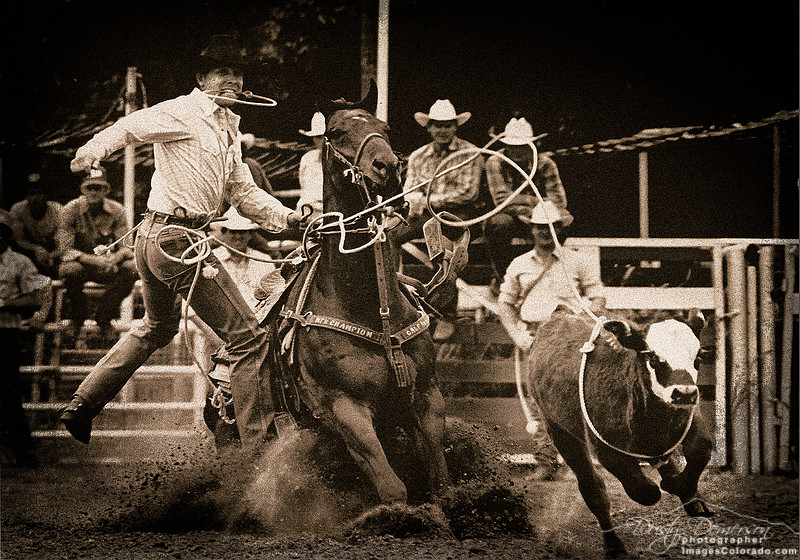
Barry Burk NFR Champion Calf Roper
It's been nearly 40 years ago since I worked for a daily newspaper. It was an exciting job and offered different challenges every single day. I wasn't a huge sports fan but I spent 2/3 of my time photographing football, wrestling, basketball, baseball, and every other sport a high school or college student might play. I even covered some rodeos. As it turned out, one of the best calf ropers in the world at the time lived just down the road from me in Comanche, Oklahoma. His name is Barry Burk. I never really got to know Barry but he became the subject of a few photos for the Duncan Banner in those days. At most calf roping events I liked to put myself and my cameras perpendicular to the gate and where the calf would usually run. This made focus a lot easier and I could usually just concentrate on the timing and the action. This approach put a big gap of space between the rider and the calf but I would usually get a decent photo. Sometimes the horse or the calf wouldn't even be in the shot. All the useable photos tended to look the same with a horse and rider, a long loop of rope, and a calf at the end of the rope. At this particular roping event, I'm sure I made those same photos to guarantee I had a shot but I wanted something more, something different. So, I moved around opposite the gate so the action would be coming straight at me. This made focusing a lot harder. What should be in focus? The calf? The horse? The cowboy? Plus, this approach put a bunch of other cowboys in the background which can be pretty distracting. As my luck had it, Barry Burk was up next. Barry was the fastest roper I had ever seen. The way he and his horse worked together was amazing. If my memory is correct, he had his calf down and tied in under 5 seconds. Amazing! Lots of other ropers were chasing calves around for three times that. The photo above is my all-time favorite rodeo photo. It has all the action and drama I was hoping for. The calf is running into the loop. The rope is looping through the air. The horse is in full-stop. Barry is out of the saddle and ready for action. The lettering on the bridle was an added bonus that completed the story. I don't even mind the cowboys in the background. Their faces express the fact that they just got beat by one of the best. When working as a photojournalist it's always the goal to tell the whole story in a single photo. It's a goal we don't often achieve but it's worth working toward. This photo gets about as close to telling the whole story as any I have ever shot.
How the Art Happens - Fire on the Mountain
August 14, 2019
•
3 Comments
Fire on the Mountain I hear that our planet is warming up. From personal observation, living up in the Colorado Rocky Mountains at 9,400' above sea level, I can verify that winters have become shorter and summers longer over the past 31 years. For us photographers, there is some benefit to this climate change. The odds of getting fresh snow while the aspen trees still have leaves has become a regular blessing rather than a lucky occurrence. The south side of Gothic Mountain is cone-shaped and rises from a dense aspen forest. On really colorful years, these aspen trees sport colors ranging from bright yellow to an almost copper color. If you can also summon some fresh snow and a clearing sky, you might capture a really beautiful photograph. The day "Fire on the Mountain" was captured began with an early-morning photo tour and ended at this location a few hours before the sky began to clear. We waited for half an hour or so before giving up on having a great sky. We still made some interesting images but, without the direct sunlight, the aspen trees were a little dull. I took my client back to her hotel and headed home for some lunch. After an hour or so it looked like the clouds might break up so I headed back up Washington Gulch to see if I could get some luck with the leaves. I ran into another photographer/friend who had been waiting at this same location but had given up. We just traded places! I didn't really have anything else to do that afternoon so I made my self comfortable after setting up to create a panorama if the clouds parted. An hour or so later the sky decided to cooperate and sunlight slowly penetrated the cloud cover bringing a beautiful glow to the golden aspen forest. I got my shot! Sometimes, if you're patient and you set up and wait, you'll get lucky. If you don't set up, you'll never get lucky! Landscape photography is a game of patience, planning, persistence, and, sometimes, a little luck. "Fire on the Mountain" is the result. How the Art Happens - Watermelons
August 07, 2019
•
Leave a Comment
Watermelons I used to travel through the panhandle of Texas several times a year to visit family in southern Oklahoma. I did this for over 30 years. When you travel the blue highways of America, you get used to seeing scenes of "Americana". Regular folks utilize and re-task items they have on hand for new tasks and purposes. You just don't see these scenes on an interstate. Such is the case in Hedley, Texas. Monroe's Peach Ranch has re-purposed an old Chevy truck into signage for their fruit stand along US highway 287. I had driven past this scene dozens of times and had always intended to stop and photograph this old truck. On this morning journey, a heavy fog covered the Texas panhandle reducing visibility to a few hundred yards. The fog also removed almost all the color from anything more than a few feet away. The fruit stand was also closed, removing additional cars and people from the scene. This was the day! I turned around, came back to the stand, and found a place to park so my truck was not in the scene. As I approached the old truck it emerged from the fog and took on a surreal blue glow. It seemed to jump out of the scene. What luck! The fog reduced the color saturation of everything but my subject, helping to isolate the truck from the background. I made several images from near and far, at several different focal lengths. This wide-angle view centers attention on the truck and diminishes attention to the building and traffic. It was pretty breezy so I had to try multiple shots to get the flag completely unfurled. To me, the flag is a critical portion of the subject. I am a little annoyed by the blurry semi coming through the scene but, at least it was white, and didn't compete too much with my subject. I traded the perfect flag for the blurry truck. I really didn't notice the truck when I was photographing since there was a lot of traffic coming through the scene. That's typical of US 287. Some of them even honked and waved. I think I captured a nice bit of "Americana" with "Watermelons". I hope you like it too! How the Art Happens - Whetstone Mists
August 03, 2019
•
Leave a Comment
Whetstone Mists Whetstone Mountain is, in my opinion, the most photogenic mountain in the Crested Butte area. I say this because it gets great light almost all day long. It's also large and imposing as mountains should be. Another reason I love this mountain is that it can be a great backdrop to scenes from several surrounding valleys, like Brush Creek. The winter of 2006/2007 didn't bring a lot of snow and spring came pretty early around Crested Butte. Roads that were typically snow-covered opened early in April instead of May or June. The Brush Creek drainage is one of my favorite places to photograph mostly because of these ranch buildings and the backdrop of Whetstone Mountain. Due to the lack of snow, I was able to travel up Brush Creek Road a bit to get this composition. We had had some fresh snow overnight but not enough to close the road. The storm was clearing (probably my very favorite time for landscape photos) and was leaving whispy clouds around the mountain. The fresh snow had covered the fields and roofs, hiding a lot of brown ugliness that would normally ruin this scene. I made this photo on April 5, 2007. I made a few compositions and played with both portrait and landscape orientations. I tried to use the rustic fence beside the road as a leading line or, at least a foreground, with poor results. This appears to be the best and most simple composition. But there was something that did not work for me. At the time, I couldn't quite figure out what I didn't like about the image. The sky in the original was blue. It was the only color in the scene. It was distracting. But, it took some time (several years) for me to figure out the problem. A few years later I was experimenting with different ways of converting color photographs to black and white. I needed a sample image to practice on and, by luck, I picked this one. With just a few mouse-clicks on some unused Photoshop tools, I had transformed an image I liked into one I truly loved. Sometimes less is more! "Whetstone Mists" has been a popular image ever since and has been printed up to 40" x 60". With a grey or black rustic frame, it looks amazing! An added bonus to being out early, after a storm, is that you get to talk to the rancher, Mr. Veltri.
How the Art Happens - Daybreak Crested Butte
July 24, 2019
•
1 Comment
Daybreak - Crested Butte, Colorado Crested Butte, Colorado got its start in the late 1800s as a mining town. Like many other mountain towns of that era, the architecture was mostly Victorian in nature. While the original buildings were probably not as colorful as they are today, the style and influence of the Victorian era are unquestionable, especially along the commercial corridors. For those lucky enough to experience Crested Butte's Elk Avenue (main street) without cars or pedestrians, the colorful storefronts can invoke a romantic storybook feeling. In mid-winter with lots of snow, the feeling is even stronger. It's really a magical place but you have to get up early to experience the full effect. My morning routine includes going out for breakfast, usually at Paradise Cafe. My favorite cafe was located in the middle of town until a few years ago. On this particular morning, I was the first car on the street. An overnight storm was just clearing and it was still snowing lightly but the sky was slowly getting lighter bringing an interesting glow to the landscape. I grabbed my camera! I photographed the scene from several vantage points and in both landscape and portrait orientations. It seems the best location was from the middle of the street with a short telephoto lens. The short telephoto lens helps to subtly compress the distance back to the Old Town Hall building on the right. The bell tower feature of that structure creates a logical stopping place while viewing the photograph. The angle of the tracks through the snow and the storefronts pull the viewer's eyes from left to right and front to back. Fortunately, the snow banks on the curbs were just high enough to hide the sidewalk and the foundations of the buildings. The storefronts in Crested Butte are pretty colorful but not nearly as saturated as they are in this photograph. To enhance the storybook feel, I increased the saturation of the scene and made it a touch lighter than reality. The falling snow added a soft-focus effect to finish creating the romantic, storybook, feeling of "Daybreak - Crested Butte, Colorado". These days the Town of Crested Butte rarely allows the banks of snow on the edge of the road so this scene is no longer possible. Most photographers hate the snow management plan used today! I'm glad I was able to capture this scene on February 20, 2010.
How the Art Happens - Busy Corner
June 27, 2019
•
Leave a Comment
Busy Corner I moved to Colorado from southern Oklahoma. Until recently, I still had family living in Duncan, Oklahoma and traveled back there at least once a year. But, I had been traveling this route for a long time before relocating to Colorado. We started vacationing in Colorado in the late '60s. So, I've been traveling across southern Oklahoma for nearly 50 years. The drive across southern Oklahoma is much like lots of rural American drives through the plains states. There are lots of small towns with boarded-up buildings, tumbling-down houses, and no sign of industry or income. These once thriving small towns are now home to only a few residents and even fewer businesses. The more bustling towns have a cotton gin, a 7-11, and, maybe, a bank. That's about it. I do love driving through rural America though. Some might find it depressing but I think most of the surviving residents are in these towns by choice and they usually make the best of their circumstances. At least visually. I'm sure I've driven through Hollis, Oklahoma over 100 times without ever noticing the "Busy Corner". It was just another remnant from more prosperous times long-gone. But this one time an old red truck caught my eye as I drove past. I circled the block and came back to explore the situation. What I discovered was pure, visual gold! As I looked around a bit more I saw the sign. Then the theater seats. Then the textures in the glass blocks. And, of course, the crunched corner of the canopy. I could almost hear a thousand stories from this old gas station. I had to get some pictures! The shadows cast by the canopy against the bright sunlit sky were going to be a problem. I knew I was not going to get the vibrant, saturated color of the truck and the pumps to have any "punch" with normal, single exposure. I could not sit and wait for the light to change and the building faces north so direct light would never illuminate the truck. I had to adopt a "plan B". In these situations "plan B" usually involves a technique called HDR or High Dynamic Range photography consisting of combining several exposures into one that is blended to bring highlights and shadows together. This technique is sometimes difficult to control since we're kind of at the mercy of the software combining the images. So many HDR photographs end up being way oversaturated and looking a little like a cartoon. "Busy Corner" ended up this way too. But, I liked it. I think the false-color approach actually helps tell the stories of this abandoned gas station. I've been by it a few dozen times since this photo was created. It's never looked the same or as good as it did on November 29, 2011. What stories does "Busy Corner" remind you of? How the Art Happens . Christmas in Autumn
June 19, 2019
•
Leave a Comment
Christmas in Autumn Contrasts have become a theme in my photography. Whether it's a shadow on white snow, a warm color against a cool color, dark against light, or a conifer in a sea of deciduous trees, I seem to be drawn to contrasts. Many of my very favorite images feature some type of contrast. "Christmas in Autumn" is no exception. I just really enjoy the contrasting shape of the conifer against the straight, white, tall aspen trunks. The dark tones of the pine also contrast nicely with the lighter trunks of the aspens. The addition of the fallen aspen leaves are a major bonus and really help the pine tree "belong" in the scene. The leaves provide a relationship between the competing species. Visually, the leaves just tie the image up in a neat little package. The panoramic format was chosen for a couple of reasons. If I had photographed the scene in a more traditional 2:3 or 4:5 ratio the scene would have included a lot of bright sky which would draw attention away from my subject. The placement of the pine tree 1/3 into the left of the scene seemed to be the most comfortable placement. It's hard to put the reasoning behind a chosen composition into words sometimes. This is one of those times. The longer format of the panorama helped me emphasize the continuation of the aspen forest which makes it feel much larger than it might have in a more traditional format. The original image was photographed using a Hasselblad XPan camera which captures a dedicated panoramic format image on film. The lens was a 90mm which helped compress the depth of the forest. The light in the image is really important, in my opinion. Bright, overcast lighting is probably my favorite light for almost every subject. That is especially true for fall color and aspen forests in particular. Bright, direct sunlight creates deep shadows and bright highlights which tend to compete with the way I think the forest feels. It shouts when I want to whisper! Most of my favorite images are photographed with softer, diffused light. I knew when I made this photograph that I had exactly what I was hoping for. It's a photograph that seems to represent something different to everyone who sees it but it almost always evokes some kind of response. A funny sidebar to this story is, years later, as I was cleaning out old, unused, unsuccessful photos, I found three other versions of this scene in different seasons. I had forgotten that I had made the pictures since none of them created the emotional response I was hoping for. All of them were made using exactly the same composition. Thanks for reading the story of "Christmas in Autumn". I've been sharing this photograph as archival paper prints and gallery-wrapped canvas prints for a few years now. It's one of my favorites!
How the Art Happens - Silverton, Colorado
June 12, 2019
•
Leave a Comment
Silverton, Colorado Silverton, Colorado is a former mining town located high in the San Juan Mountains of Colorado. Many of the buildings in the town date back to the early mining days over 100 years ago. Like many of Colorado's old mining towns, Silverton's current claim to fame is tourism. Being the destination of the Durango to Silverton railroad keeps it hopping with visitors. Silverton is also famous for being on the National Register of Historic Places. In 1951 Ansel Adams visited Silverton and created a few images. His most well-known is a photograph of this church. The forms of the roofs and the contrast of the white church and dark surrounding buildings always intrigued me. Artistically, our eyes are usually drawn to areas of higher contrast and lighter tones generally dominate our attention. Naturally, my eye goes to the church. I visited Silverton a few years ago and was captivated by the old wooden buildings and ghost-town feel once I got off of the main street. I drove or walked every street in Silverton searching for images. I didn't have much luck. Newer cars in driveways, satellite dishes, and a host of new-fangled additions and appliances really took away from the old mining town vibe I was trying to capture. Then, I remembered the Ansel Adams photo. The church is easy to find with the steeple being visible from just about anywhere in town. So, I headed toward the church. It was still there and seemingly freshly painted. Perfect! It took a bit of work but I was able to find the exact location that Ansel made his composition. I loved the picket fence but, unfortunately, new neighbors had used it to mount a huge satellite dish. I had to do something a little different. I ended up choosing a much longer, telephoto lens, moved a block away, and created a much tighter composition focusing on the front of the church. The telephoto lens helps compress the apparent distance between foreground, subject, and background. I really liked the lines of the surrounding roofs and the contrast with the church. Moving that extra block also provided a higher point of view and let me eliminate the street. The wood smoke from surrounding homes added to the atmosphere behind the church. It also helped set the mood for the photographer who loves the smell of a campfire. This photograph was originally created in color. Color, in my opinion, sometimes detracts from my composition and doesn't always support the theme of a photograph. "Silverton, Colorado" definitely works better in the mild sepia-toned black and white on warm toned paper. I think our two images tell different stories of the same subject. Here is the Ansel Adams 1951 image:
Copyright © 2016 Arizona Board of Regents. All Rights Reserved. This is one of those images I prefer on paper. Canvas, metal and acrylic just, like the color, seem to compete with the emotion of the subject matter. You can see my matted and framed version of "Silverton, Colorado" here.
© ©
How the Art Happens - Fearless
June 05, 2019
•
1 Comment
Fearless Every winter our search and rescue organization hosts the best films from the Banff Mountain Film Festival. They take over the Center for the Arts and we get to watch some great outdoor-oriented films. Banff also hosts a photography competition and the winning photographs are featured in the programs and on the screen between films. To say that these films and photographs are inspirational would be a huge understatement. Back in 2005 I attended the two nights of films and was captivated by another photographer's photo of shadows on the snow. Since I live in a snowy environment I was surprised by the fact that I never attempted to use shadows on snow as a subject or to support a subject. I mean, I was really surprised! I was so surprised that I went out the following day with a mission of using shadows on pristine white snow to tell some kind of story. This new idea was going to require some solitude and privacy so I headed up Taylor Canyon. I woke to fresh snow and sunshine so some of the elements were already aligned. I just needed a subject and some shadows. Taylor Canyon is one of my very favorite places to explore but, to be candid, I haven't made very many successful photographs up there. It's a bit overwhelming and trying to organize cohesive compositions can be difficult. I slowly worked my way up the canyon creating images that were not really what I was hoping for. The river and the forests just weren't really speaking to me. Finally, just below the Taylor Dam, the hillside opened up with beautiful, long shadows of the towering pine trees above. This is what I was looking for! But the shadows alone were not telling the full story. That's when I found the little tree. Now I have a story! I was mostly photographing on film back in 2005 and on this particular day I had left the shop without enough. As I worked to refine the composition and lens selection I exhausted my supply. I still had not composed a really strong image so I grabbed my Nikon Coolpix 8800 digital camera I used for a backup and continued to refine my image. The threatening shadows and the singular small tree represent a story that most of us can relate to at some point in our lives. Once I had the image above, I knew I had what I came for but it was on my digital "point and shoot" camera. (sad face) I rarely compete in photo competitions but the following year I entered this photo in the Banff Photography Competition since that's where I got the original inspiration. In May I was headed out of town when my cell phone rang. It was Banff calling. I had won first place in the photography competition. There was only one problem. When I submitted the photo I didn't have a title for it so I just used the filename. The woman from Banff said I had to have a title. While driving over Kebler Pass, talking on the phone to a woman from Canada, it hit me. "Fearless" would be the perfect title. She agreed. "Fearless" has been one of my most successful images and has been featured at Banff and in National Geographic as well as decorating the walls of many homes and offices. Today, this little tree has its own little tree beside it creating a completely different story.
|